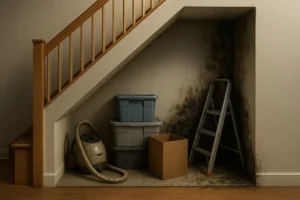
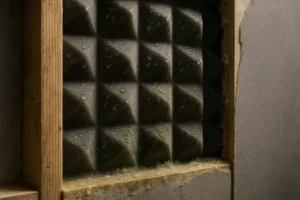
Your floating floor is acting weird. Edges are lifting like badly waxed eyebrows, there is a gym-bag funk that refuses to leave, and your dehumidifier is working overtime. You do not see blotchy spots, but that does not mean you are in the clear. Mold under laminate or LVP loves to set up shop where you cannot see it, partying between the slab, underlayment, and planks. The good news: you can often find it, treat it, and fix the moisture problem without bulldozing your entire floor. Welcome to the practical world of surgical lifts and subfloor vapor mitigation, where we target the problem surgically and stop it from coming back.
Hidden Mold Under Floating Floors
Hidden mold under floating floors usually starts with moisture that sneaks in from below the floor or gets trapped above the slab. Concrete slabs constantly release moisture vapor until they fully equilibrate, and that can take years. If that vapor meets a cool laminate or vinyl plank with an underlayment that acts like a sponge, you get a sticky microclimate perfect for mold. You might notice a musty odor, faint darkening at edges, cupping or peaking, or suspicious gaps at transitions. Those are classic early-warning signs touched on in hidden mold guides like this one, plus general flags like swelling, stains, and recurring odors referenced in professional mold removal overviews here.
Healthwise, any indoor mold problem is worth taking seriously. Odor alone means microbial activity. Structurally, persistent moisture degrades adhesives, softens MDF core laminates, and can corrode fasteners at transitions and door casings. Financially, ignoring vapor drive or a sneaky leak turns a simple repair into a full-floor redo. Let us not.
How Do You Confirm It Without Wrecking The Floor?
Before you start ripping planks, map the moisture and verify where the problem actually is. Non-destructive testing lets you pinpoint trouble with minimal disruption.
Start with moisture meters. A quality pinless meter gives fast scanning across LVP or laminate to find anomalous readings. A pin-type meter with insulated pins lets you check underlayment and wood-based subfloor materials right through small gaps or removable trim. Pair meters with a hygrometer to read indoor relative humidity and temperature. Mold risk jumps when surface-relative humidity at the materials stays high long enough, which often correlates with indoor RH over 60 percent and damp material readings.
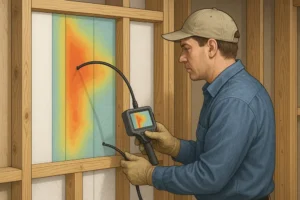
Use thermal imaging as a roadmap. Cooler areas can signal evaporation or trapped moisture. Infrared is not a moisture meter, but it speeds up the hunt so you know where to verify with a meter or probe. Many restoration pros combine thermal imaging and moisture meters during initial assessments, as outlined in mold removal service pages like this one.
Check discreet inspection points before touching planks. Pop off a piece of quarter-round or shoe mold to expose the expansion gap and peek with a borescope. Remove a transition strip between rooms and scout the edge. If you have a floor vent, use it as an observation port. You are looking for gray-green growth on the underlayment, dark smudges on the slab, or condensation. Your nose helps too. If you catch that earthy odor even stronger at gaps, you are close.
If your slab is suspect, measure slab moisture correctly. For concrete, in-situ RH testing per ASTM F2170 is the industry standard for evaluating readiness for resilient flooring. Many LVP and adhesive manufacturers set limits around 75 to 85 percent RH, though you must always check product specs. You will also see legacy calcium chloride tests per ASTM F1869 that report MVER in pounds per 1000 square feet per 24 hours. RH testing gives a more reliable picture of vapor in the slab body. You can read about F2170 concepts here.
When Is A Surgical Floor Panel Lift The Right Move?
A surgical floor panel lift is a targeted, minimally invasive removal of only the planks necessary to inspect, dry, clean, and repair the affected zone. Instead of rolling the dice on ripping half your house apart, we lift a small, defined area, remediate correctly with containment and HEPA control, then put the floor back together.
Choose a surgical lift when the problem is localized, the flooring is a floating click-lock system, the underlayment is intact outside the target zone, and moisture mapping shows defined boundaries. If your thermal and moisture map lights up only around the fridge line, a dishwasher leak, a sliding door threshold, or a single interior wall, that is prime surgical-lift territory. If the entire slab is running hot on RH or you have widespread cupping and odor, a surgical lift becomes triage instead of cure. In that case, you fix the vapor drive first and consider a larger scope.
How We Perform A Surgical Lift
Before tools touch the planks, we mark boundaries using the testing results. Then we suit up and set the controls. Even a small lift can aerosolize spores and fragments if you are careless, so play it like a pro.
We isolate the work area with 6-mil poly and painter’s tape or a pole system. A HEPA air scrubber runs inside the containment and vents out, creating negative pressure that keeps dust and spores from drifting. We HEPA-vacuum surfaces to knock down settled dust before we open anything. Proper PPE goes on for anyone inside containment.
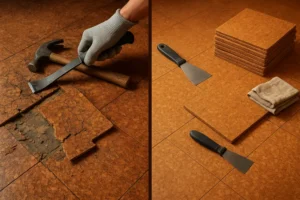
Next, we access the planks. The cleanest option is to remove baseboard or shoe mold on the nearest wall and unclick rows backward until you reach the target panels. If your jobsite layout makes that impossible, we perform an in-place panel extraction. That looks like masking the surrounding planks with low-tack tape, marking a plunge-cut on the damaged panel, and using an oscillating multi-tool and track to cut the panel free without nicking neighbors. Suction-cup lifters help lift LVP cleanly. With laminates, protect edges to prevent chipping. Save any trim and intact planks for reinstall.
Once a panel is up, we remove wet foam underlayment in the affected zone and bag it in-containment. If mold is visible on the slab, we HEPA-vacuum the surface and wipe with a detergent solution. If the subfloor is wood, we HEPA-vacuum, then wet-wipe and dry. We do not fog and pray. Fogging is not a replacement for physical source removal.
We treat cleaned surfaces with an EPA-registered antimicrobial as a sanitizing step after physical removal of growth. Then we dry surgically. Targeted drying beats noise-and-hope. We use focused dehumidification, air movement directed across the slab or subfloor, and where needed, suction-floor-mat systems to pull moisture out from under edges. Instruments verify progress throughout. No reinstall until readings are back to safe ranges that match the rest of the floor. That usually means wood-based materials near equilibrium moisture content for your region and slab RH compliant with your flooring spec.
Reassembly comes last. We install fresh underlayment with a proper vapor retarder if needed, replace planks with matching stock, and lock them in. Joints at transitions get sealed as appropriate for the flooring line. Baseboards or shoe mold go back on. The repaired area should be invisible to the casual eye and odor-free.
Drying, Cleaning, And HEPA Control
Effective remediation is not just about what you remove. It is about what you prevent from spreading. Containment, negative pressure, and HEPA filtration are mold’s worst enemies. HEPA filters capture 99.97 percent of particles at 0.3 microns. Set the air scrubber inside containment and duct to the exterior or a low-risk zone. Keep doorways sealed. Open-air cleaning around the rest of the home is not remediation.
Cleaning is a two-step: remove contamination physically, then apply a sanitizer. HEPA vacuum hard, wipe with a surfactant cleaner, then use an EPA-registered antimicrobial that is compatible with your substrate. Do not soak wood subfloors. You are sanitizing, not marinating. Avoid straight bleach on porous materials. Agencies like the EPA caution that bleach does not reliably penetrate and can create corrosion and off-gassing issues. For household-scale guidance on when DIY is reasonable, see the EPA’s mold cleanup page here.
Drying is instrument-driven. Target 30 to 50 percent indoor RH during and after remediation. Air movers should promote evaporation across the slab or subfloor, not blast directly into containment seams. Dehumidifiers must be sized to the room volume. Keep HVAC in play to help stabilize conditions, but set the fan to Auto so you are not re-evaporating condensate off coils all day.
Subfloor Vapor Mitigation That Actually Works
If the moisture source is the slab itself, you will be on a treadmill until you fix vapor drive. Subfloor vapor mitigation is the suite of steps that keep moisture vapor from pushing into your floor assembly again.
Start with testing and specification. Perform ASTM F2170 in-situ RH tests after any flood-dry to get a real number for the slab’s internal RH. Cross-reference your flooring manufacturer thresholds. If you are high, you have options. One route is a Class I vapor retarder underlayment system designed for floating flooring. Another is a liquid-applied, two-part epoxy moisture vapor barrier rated for concrete. ASTM F3010 covers vapor mitigation coatings for slabs with high RH. A correctly installed epoxy system can knock down permeance to very low levels, giving you a safer substrate for LVP or laminate. You can read a standard overview page for F3010 here.
For lighter vapor loads, a high-quality underlayment with an integrated vapor barrier or a 6-mil polyethylene sheet with taped seams can be enough. Overlap seams at least 6 inches, tape them tight, and turn the barrier up the wall an inch or two so it tucks behind the baseboard. The barrier should be continuous under transitions and thresholds. Gaps at doorways and stair noses are notorious moisture shortcuts.
Perimeter sealing is the secret sauce. Seal slab-to-wall joints with a backer rod and a polyurethane or hybrid sealant to block humid air from pumping into the underfloor. Seal pipe penetrations, floor drains that are abandoned, and cracks big enough to be air pathways. If you ever wondered why the odor gets stronger when the HVAC kicks on, it is because pressure changes push air through those gaps like a bellows.
Control ambient humidity long term. Maintain 30 to 50 percent RH in living areas, and use a stand-alone dehumidifier in basements or slab-on-grade spaces that want to creep higher. If you have one of those open-floor-plan spaces that turns into a swamp every summer, consider a ducted whole-home dehumidifier. All Nation’s prevention articles recommend similar targets and quick drying after any water exposure, which you can see mirrored in their tips here.
Surgical Lift Or Full Replacement?
There is no trophy for replacing a whole floor when a surgical approach would have done the job. There is also no trophy for patching a local spot when the entire slab is bleeding vapor. Choose based on scope, structure, and testing, not hope and a guess. Here is a quick comparison to keep it honest.
| Scenario | Best Path | Reason |
|---|---|---|
| Localized leak near fridge or dishwasher | Surgical floor panel lift with containment | Damage is bounded and repairable without nuking the floor |
| Widespread musty odor and cupping across rooms | Vapor testing, slab mitigation, larger demo scope | Likely slab vapor drive affecting a broad area |
| Moldy foam underlayment but clean slab | Targeted underlayment replacement, dry and sanitize | Foam acted like a sponge and can be swapped |
| Wood subfloor with delamination or rot | Remove and replace compromised subfloor sections | Structural failure cannot be salvaged with cleaning |
| High slab RH by ASTM F2170 | Install epoxy MVB or approved vapor retarder system | Stops vapor at the source before reinstall |
Prevention That Keeps Floors From Fighting You
Good prevention is boring, which is exactly what you want. Keep water out, keep vapor in check, and keep humidity in-range. Fix leaks fast. Dry wet floors within 24 to 48 hours. Use door sweeps and thresholds that actually seal. Caulk shower enclosures, tub aprons, and exterior doors. Grade soil away from slab edges and keep sprinklers off the foundation. Indoors, do not let RH cruise above 55 percent for weeks. Set your AC to reasonable temperatures and let it cycle long enough to wring moisture from the air.
When choosing underlayment, use a product that matches your flooring and slab conditions. Some underlayments are breathable and are better above wood subfloors that need to exchange moisture. Others include robust vapor barriers for direct-to-slab installs. Read the data sheet, not just the retail box. Make sure your installer tapes seams where the manufacturer requires it. If you are tackling a DIY repair, line up the exact replacement planks in the correct lot number so color and click profiles match.
When You Should Call A Pro
If the moldy area is over about 10 square feet, the EPA pushes you toward professional remediation. If anyone in the home has asthma, allergies, or immunocompromised conditions, call sooner. If you have repeated odor after attempts to clean, do not keep rolling the dice. You want a contractor that performs actual moisture testing and mapping, uses real containment and HEPA air filtration, can execute a surgical floor panel lift, and can specify subfloor vapor mitigation that fits your slab and flooring. Look for companies that follow modern industry guidance like IICRC S520 for mold remediation. You can read about IICRC standards here. For an overview of what professional remediation looks like, All Nation Restoration outlines typical steps such as containment, HEPA, and careful drying on their service page here.
FAQ: Straight Answers
How can I tell if there is mold under my LVP without ripping it up?
Use your senses and your meters. Musty odor that is stronger at edges and transitions, slight peaking or soft spots, and elevated readings on a pinless moisture meter are strong clues. Confirm by removing a small piece of shoe mold or a transition strip and checking with a borescope.
Can I reuse lifted planks after a surgical floor panel lift?
Often yes, if you back out rows from a wall and protect the locking edges. If you must cut a plank out of the field, you typically replace that one with a new plank. Keep extra boxes of your flooring line for exactly this reason.
Do I really need containment for a small mold lift?
Containment is not overkill. Even small jobs can aerosolize fragments and spores if you run saws and pry bars in open air. A simple plastic enclosure with a HEPA air scrubber is fast insurance.
Is bleach a good idea on a slab or subfloor?
Not recommended. Bleach does not reliably penetrate porous materials and can corrode metals or discolor finishes. Physical removal plus detergent cleaning and an EPA-registered antimicrobial is the standard approach referenced by agencies like the EPA.
How long does it take to dry a slab after a leak?
Anywhere from a day to over a week depending on ambient conditions, airflow, and whether you are drying through a finish. Instruments decide, not the calendar. Do not reinstall flooring until your slab RH or subfloor moisture content is in-spec.
What is subfloor vapor mitigation in plain terms?
It is how we block moisture vapor from moving into your floor assembly. That can mean a liquid-applied epoxy moisture vapor barrier on the slab, a high-performance underlayment with a built-in vapor retarder, or both. It also includes sealing perimeter gaps and penetrations so humid air is not pumping under the planks.
Do I need to test the mold species?
Usually no. For building remediation, the priority is finding and fixing moisture, removing contamination, and verifying dryness and cleanliness. Species testing can be useful in special cases, but it is not required to do good remediation.
Will a dehumidifier alone stop subfloor mold?
It helps, but it will not fix slab vapor drive by itself. You still need a continuous vapor barrier strategy and perimeter sealing if the slab is the source.
Field Notes From Real-World Jobs
One kitchen install had perfect-looking LVP but a five-star musty smell every time the AC cycled. Thermal imaging showed a cool band along the back wall run. Meters confirmed damp readings across a two-foot strip. We popped shoe mold, checked the expansion gap, and found mold on the foam underlayment where the slab met a leaky sill plate. A surgical floor panel lift exposed the zone, we removed the fouled foam, HEPA-cleaned and sanitized the slab, sealed the plate joint with backer rod and polyurethane, installed a vapor-retarder underlayment, and reinstalled planks. Odor gone. Floor saved.
Another case was not a surgical candidate. A basement family room showed cupping everywhere, and F2170 tests came back in the 90s for slab RH. We dried, then applied a two-coat epoxy moisture vapor barrier system per manufacturer specs, used a compatible underlayment, and reinstalled LVP with perimeter seals and a whole-home dehumidifier set to 45 percent RH. No more swampy Saturdays.
Your Next Move
If your floor smells funky and acts like it is trying to escape its own edges, do not ignore it. Start with non-destructive checks. If the readings point to a localized hit, a surgical floor panel lift is often the smart, fast play. If testing shows the slab is pushing vapor everywhere, tackle subfloor vapor mitigation first so your new floor does not suffer the same fate. If you want a deeper walk-through of warning signs and pro steps, scan All Nation Restoration’s guides on hidden mold and their mold removal process. When the job is bigger than a weekend, bring in a team that speaks the language of meters, HEPA, and standards. That is how you fix it once.