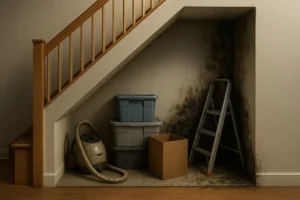
Under-stairs moisture often hides in plain sight. Boxes cover the coldest parts of the wall, coats block air movement, and the door may stay closed for weeks. When humid indoor air reaches those cool surfaces, stairwell storage condensation can dampen cardboard, drywall, wood, carpet, and ordinary household dust enough to support mold. No dramatic pipe burst or visible puddle is required.
That doesn’t mean every musty cupboard has a condensation problem. A leaking pipe, foundation seepage, wet flooring, an exterior-envelope defect, or moisture from an adjoining basement or crawlspace may be responsible. The trick is to identify the moisture pattern instead of spraying cleaner at the first dark spot and declaring victory.
Why Mold Develops Under a Staircase
An under-stairs cupboard is often a nearly perfect moisture trap. It has an awkward shape, little natural airflow, and plenty of surfaces that rarely see daylight. Add tightly packed storage, and air can’t circulate behind boxes or shelving.
Surface temperature is a major part of the problem. Exterior walls, foundation walls, concrete floors, garage-adjacent partitions, and uninsulated cavities may remain cooler than the rest of the room. Framing members and other thermal bridges can create narrow cold areas even when most of the wall feels comfortable.
Warm air entering the enclosure carries water vapor. As that air cools near a cold wall, its relative humidity rises. If the surface temperature reaches the dew point, liquid condensation can appear. Mold may begin growing before droplets are visible because the thin layer of air next to the wall can remain much more humid than the air near the cupboard door.
Storage contents make matters worse. Cardboard, paper, leather, books, shoes, coats, carpet, particleboard, and fabrics absorb moisture. They also collect dust and provide organic material on which mold can grow. A cardboard box pressed against cool drywall is less like storage and more like a moisture sandwich.
Some staircases also conceal plumbing lines, pipe chases, ducts, or walls shared with bathrooms, kitchens, and utility rooms. Those features create additional opportunities for leaks and condensation. Since few people routinely inspect the triangular corner behind the holiday decorations, damage can continue for months.
Condensation or a Hidden Leak?
The location and timing of dampness can help narrow the cause, but they don’t provide a guaranteed diagnosis. Condensation usually produces a broader moisture pattern associated with cold surfaces and poor airflow. A leak often creates a concentrated wet area or follows rain, plumbing use, or appliance operation.
| Clue | More Consistent With Condensation | More Consistent With a Leak |
|---|---|---|
| Location | Across a cold exterior or foundation-facing wall, especially behind storage | Below a pipe, bathroom, appliance, roof intersection, or specific exterior defect |
| Timing | Worse during humid weather or when surfaces become cold | Appears after rain, snowmelt, plumbing use, or repeated drainage events |
| Appearance | Scattered spotting, light corrosion, or broad surface dampness | A defined stain, swollen trim, bubbling paint, or one persistently wet section |
| Drying Pattern | Improves with controlled humidity and appropriate air movement | Returns despite normal indoor humidity |
| Likely Response | Humidity control, air sealing, insulation, and storage changes | Repairing the plumbing, drainage, foundation, roof, or exterior defect |
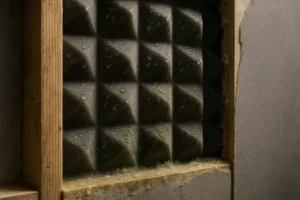
White, powdery deposits on concrete or masonry are another clue. This material is often efflorescence, which forms when water moves through masonry and leaves mineral salts behind. It isn’t mold, but it does indicate moisture movement that deserves investigation.
Dark staining shouldn’t automatically be called “toxic black mold,” either. Color doesn’t identify the species, exposure level, or cleanup method. Green, white, gray, brown, and dark-colored growth can all occur in damp buildings. Treat the moisture and contamination based on their extent and material, not their color.
Signs Hidden Behind the Boxes
A musty smell under the stairs is often the first warning. Odor can escape through the door gap long before growth is visible from the hallway. Air freshener may disguise it for an afternoon, but it won’t explain why the cupboard smells like a wet basement.
Look for irregular speckling, fuzzy patches, warped shelving, peeling paint, swollen baseboards, soft drywall, and damp carpet edges. Rust on hinges, fasteners, shelving, or stored tools may point to repeated high humidity. Condensation on pipes or masonry is direct evidence that at least one surface is becoming cold enough to collect water.
Pay attention to the contents as well. The exposed face of a box may look normal while its back and bottom are spotted or soft. Shoes and fabrics may smell musty even when the wall appears clean. Mold can also develop on the paper facing of drywall or the rear side of trim, leaving little evidence on the finished surface.
How to Inspect the Storage Area
Before opening and emptying the cupboard, smell near the closed door and inspect the door frame, baseboards, and adjoining wall. If extensive growth is already visible, don’t aim a household fan into the space. Strong air movement can distribute dust and mold particles into occupied rooms.
Use extra caution if someone in the home has asthma, significant mold allergies, chronic lung disease, or a weakened immune system. That person shouldn’t be the one moving contaminated boxes. When the suspected area is widespread, safe containment may be more useful than an enthusiastic Saturday cleanup.
- Remove belongings one at a time. Don’t shake moldy cardboard, coats, rugs, or fabrics indoors.
- Separate items into clean, questionable, and visibly contaminated groups. Check every box’s back and bottom.
- Use a bright flashlight to inspect the wall beneath the lowest treads, triangular upper corners, wall-to-floor joints, baseboards, shelving, pipe penetrations, and the back of the door.
- Pull back accessible carpet edges carefully and check the padding and tack strips for dampness or staining.
- Inspect exposed stair stringers, framing, subflooring, and the opposite side of any suspicious wall.
- Document staining, damage, and instrument readings with photographs before cleaning or discarding materials.
Collapsed or heavily contaminated cardboard generally isn’t worth saving. Bag it before carrying it through the home. Don’t transfer damp belongings directly into sealed plastic bins, since the bin may simply preserve the moisture problem in a cleaner-looking container.
What Moisture Tools Actually Tell You
A small digital hygrometer can track the enclosure’s temperature and relative humidity. The EPA recommends keeping indoor relative humidity below 60 percent, ideally around 30 to 50 percent where practical. A data-logging model is more informative than one quick reading because humidity can rise overnight, during storms, or when the cupboard door remains closed.
Still, one reading of 45 percent near the door doesn’t prove that the back wall is safe. The air touching a cold wall may have a much higher local relative humidity. That’s why checking surface temperature can be useful when stairwell storage condensation is suspected.
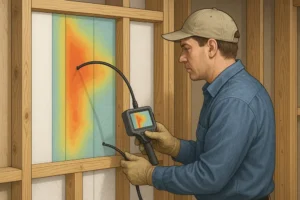
An infrared thermometer can compare the temperatures of walls, floors, and corners. A thermal camera can show temperature patterns that suggest missing insulation, air leakage, or possible wet areas. It can’t see mold through drywall, and it doesn’t directly detect water.
Pin and pinless moisture meters help compare a suspicious section with a known dry area made from similar material. Results require context. Metal fasteners, masonry salts, material density, and wall construction can affect readings. A moisture meter isn’t a mold detector, no matter what an online product listing implies.
Can You Clean It Yourself?
EPA guidance indicates that occupants can often handle an affected area smaller than about 10 square feet, roughly a three-foot by three-foot patch. That number is guidance, not a promise that every small problem is safe or simple.
Limited do-it-yourself cleanup may be reasonable when the source has been stopped, the water wasn’t contaminated by sewage, mold hasn’t entered the HVAC system, and there’s no sign of extensive hidden growth inside the wall. The person doing the work should also be able to wear suitable protection and keep debris from spreading through the home.
A small visible patch can be the edge of a larger concealed problem. For example, six inches of staining above a baseboard may accompany wet insulation throughout the lower wall cavity. Soft drywall, recurring odor, broad moisture readings, or damaged materials on both sides of a wall deserve a closer investigation.
How to Clean a Small Mold Area
Fix the water source first. Cleaning mold while the wall remains damp is maintenance, not remediation. Depending on the cause, this may require repairing a pipe, lowering indoor humidity, correcting exterior drainage, drying a wet floor, or addressing a cold surface.
For limited cleanup, wear gloves, eye protection, and at least a properly fitted N95 respirator. Hard, nonporous surfaces can generally be cleaned with detergent and water, then dried completely. Avoid aggressive dry brushing, which can launch contaminated dust into the room.
The EPA doesn’t recommend routine use of chlorine bleach or other biocides for mold cleanup. Killing or bleaching visible growth isn’t enough. Dead mold can still be allergenic, and the contamination must be physically removed. Never mix bleach with ammonia, acids, or other cleaning products.
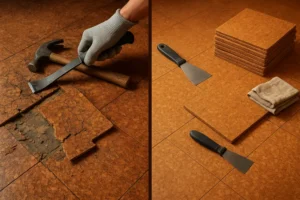
Porous materials are more difficult because growth can extend below the surface. Moldy drywall, wet insulation, carpet padding, ceiling tile, particleboard, and heavily contaminated cardboard may require removal. Some fabrics and upholstered belongings may not be practical to restore. Wood framing can sometimes be cleaned and dried, but its condition and depth of contamination matter.
Bag discarded material before moving it through occupied areas. Clean settled dust carefully, and confirm that remaining surfaces are dry. Don’t paint, caulk, or apply a stain-blocking coating over active mold or damp drywall. Fresh paint can hide the stain, but it can’t negotiate with the leak behind it.
Why Mold Testing Usually Comes Later
If visible mold and moisture are present, testing usually isn’t the first useful step. You already know that contamination needs to be removed and the moisture source corrected. The EPA states that sampling is generally unnecessary when visible mold is present, and there are no federal airborne mold concentration limits that automatically label a home safe or unsafe.
Consumer test plates aren’t reliable tools for deciding whether remediation is necessary. Mold spores naturally exist indoors and outdoors, so growing something on a plate doesn’t explain where moisture is entering, what materials are affected, or how far hidden growth extends.
Professional sampling can have a role in disputes, specialized investigations, certain medical consultations, or suspected hidden contamination without accessible visible evidence. When sampling is warranted, it should support a broader moisture and building inspection rather than replace one.
How to Stop Under-Stairs Moisture
Prevention starts with the source. Plumbing and exterior leaks need repairs. Foundation seepage may require improvements to grading, gutters, drainage, cracks, or waterproofing. A damp basement or crawlspace may need attention even when the cupboard itself has no obvious water entry point.
If high indoor humidity is contributing, use bathroom and kitchen exhaust fans during moisture-producing activities. A dehumidifier can help when it’s correctly sized and has a dependable drain arrangement. Emptying a bucket occasionally won’t control moisture if the unit shuts off while you’re away for a week.
Air sealing and insulation may help prevent humid air from contacting a cold wall or floor. The U.S. Department of Energy explains that moisture can move through leaks, air movement, and vapor diffusion, so the correct repair depends on the building assembly and climate. Adding an impermeable finish or insulation to a damp foundation wall without understanding how it dries can trap moisture rather than solve it.
Improved airflow can help, but only when the incoming air is drier than the cupboard’s air and cold surfaces. Leaving the door open during a dry, conditioned period may be useful. Leaving it open while humid summer air reaches a cold foundation wall may increase condensation.
A louvered door or transfer grille can sometimes improve circulation, but don’t cut vents without checking local building and fire requirements. Stair enclosures, garage-adjacent walls, utility spaces, and multifamily buildings may have required fire or smoke separations.
Storage habits matter too. Keep boxes several inches from cold walls where feasible, raise belongings above concrete floors, and avoid packing the enclosure from floor to ceiling. Move shelving slightly away from exterior or foundation walls so you can inspect behind it. Once the space and contents are dry, cleanable bins are usually a better choice than cardboard, but they shouldn’t be used to seal in damp shoes, clothing, or paper.
Inspect the cupboard seasonally and after heavy rain, plumbing work, long humid periods, or unusual cold snaps. Check beneath bins and behind shelves instead of glancing at the center aisle and calling it done.
Health Concerns Without the Hype
Damp and moldy environments can affect people differently. According to the CDC, possible effects include nasal stuffiness, sore throat, coughing, wheezing, irritated eyes, and skin irritation. People with asthma or mold allergies may have stronger reactions.
Symptoms alone can’t tell you the mold species, location, or required cleanup method. They also shouldn’t be diagnosed by a restoration article. Anyone with persistent symptoms should speak with a healthcare professional, especially if they have asthma, chronic lung disease, significant allergies, or immune suppression.
When to Call a Restoration Professional
Professional assessment is the safer option when the affected area exceeds roughly 10 square feet, materials keep becoming moldy, or the moisture source isn’t clear. Assistance is also appropriate when growth may extend into drywall, insulation, flooring, stair framing, or an enclosed wall cavity.
Don’t attempt ordinary household cleanup when water came from sewage or another polluted source. Professional help is also preferable when mold may be inside ducts or HVAC equipment, structural wood is soft or decayed, containment is difficult, or a medically vulnerable person occupies the home.
A proper under-stairs mold remediation plan should identify and correct the moisture source, isolate the work area when needed, remove unsalvageable materials, clean remaining surfaces, and verify that the enclosure is dry before reconstruction. Simply fogging the cupboard, painting the wall, or placing a scented moisture absorber beside the boxes doesn’t address concealed wet materials.
If under-stairs moisture keeps returning or you suspect damage inside the wall, contact All Nation Restoration to discuss a professional inspection and an appropriate restoration plan. Disturbing widespread contamination before the area is assessed can make a contained problem harder to manage.
Frequently Asked Questions
Why Does My Under-Stairs Cupboard Smell Musty?
A musty odor can indicate persistent dampness or microbial growth on hidden surfaces and stored contents. Empty the area carefully and inspect behind boxes, beneath carpet edges, around baseboards, and along cold walls. Deodorizing the cupboard without finding the moisture source usually provides only temporary relief.
Can Mold Grow Without Visible Condensation?
Yes. Relative humidity can be much higher at a cold surface than it is in the center of the room. Mold may grow on dust, paper, wood, or painted drywall before enough water collects to form visible droplets.
Will Leaving the Cupboard Door Open Help?
It may help when the adjoining air is warmer, drier, and conditioned. It can make condensation worse when humid air enters and contacts a very cold wall. Use humidity and surface-temperature readings instead of assuming more air is always better.
Should I Use Bleach on Mold Under the Stairs?
Bleach isn’t routinely recommended for mold cleanup. Limited growth on hard surfaces can generally be cleaned with detergent and water, followed by complete drying. Moldy porous materials may need removal because contamination can extend beneath the visible surface.
Can I Paint Over the Affected Wall?
No. Paint may peel or stain again when mold or moisture remains beneath it. The affected material must first be cleaned or replaced as appropriate, and the enclosure must be fully dry before refinishing.
How Far Should Boxes Be From the Wall?
There’s no universal spacing rule for ordinary household storage, but several inches of clearance can improve inspection and air movement. Keep belongings off damp concrete or basement floors, and don’t press cardboard, fabrics, or leather against a cold wall.
Why Does Mold Return After Cleaning?
Recurring mold means moisture is probably still present or contaminated material remains hidden. Common causes include elevated humidity, cold thermal bridges, humid-air leakage, plumbing seepage, foundation moisture, damp carpet padding, or growth inside a wall cavity.