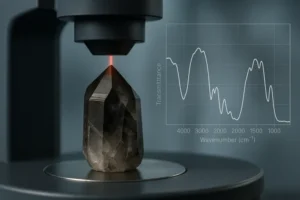
Smoke-damaged quartz can sometimes be saved, but a clean-looking surface isn’t enough to make that call. FTIR residue analysis can identify organic soot, cleaning residue, and chemical changes in the countertop resin. If there’s persistent odor or suspected quartz binder off-gassing, separate air, headspace, or chamber testing is required. One countertop wipe can’t tell you everything, no matter how impressive the laboratory report looks.
That distinction matters because engineered quartz isn’t solid natural stone. It’s a composite material held together by polymer resin. The mineral aggregate may survive a fire while the resin, seam adhesive, caulk, cabinets, or backsplash mastic takes the hit. A defensible restoration decision has to account for the whole installation, not just the shiny part you can see.
Quartz Is a Composite, Not Just Stone
Engineered-quartz countertops generally contain crushed quartz or other mineral fillers, pigments, additives, and a polymer binder. Many traditional products contain a high percentage of crystalline silica, while the binder often makes up a much smaller portion of the slab. That small portion does a big job. It holds the aggregate together, contributes to the color and gloss, and helps create the low-porosity surface people associate with quartz.
After a fire, the mineral and polymer components don’t respond the same way. Quartz particles can remain apparently unchanged while the resin between them yellows, oxidizes, softens, becomes brittle, or loses its grip on the aggregate. The countertop may remain flat and glossy even though its outer resin layer has been chemically altered.
This is why using quartz’s mineral phase transition near 573 degrees Celsius as a salvage threshold makes no practical sense. A countertop’s polymer binder, pigments, caulk, seam material, installation adhesive, and supporting cabinets can be damaged at much lower temperatures. There isn’t one magic temperature at which every engineered-quartz slab becomes bad.
Product identification helps. If the brand, color, installation date, and product line can be documented, the restoration team can review the manufacturer’s heat and cleaning guidance. For example, Caesarstone’s care guidance addresses heat exposure, cleaning, and routine sealing for its products. Guidance from one manufacturer shouldn’t automatically be applied to another brand, though. Quartz formulations aren’t universal.
Heat Usually Attacks the Binder First
Heat damage isn’t always a dramatic crack through the middle of an island. It can show up as a dull patch, yellow halo, hazy finish, tacky area, distorted edge, failed seam, or subtle change in texture. Concentrated heat near a cooktop can also affect seam adhesive or the underside of the slab without producing an obvious mark on top.
Consider a light-gray countertop next to a stovetop fire. The visible soot cleans off, but a two-foot area remains slightly yellow and loses gloss whenever light hits it from the side. That may be more than staining. It could indicate oxidation or another heat-related change in the resin. Scrubbing harder won’t reverse damaged polymer, and an aggressive solvent may make the finish worse.
At the other end of the scale, imagine a quartz island 12 feet from a small kitchen fire. It has a greasy black film but no discoloration, cracks, odor, seam damage, or physical change. A controlled cleaning trial removes the film, and post-cleaning testing closely resembles an unaffected control area. Replacement in that situation might be an expensive answer to a removable-residue problem.
Visible condition still matters, but it isn’t the only evidence. The inspection should look for gloss loss, pitting, blistering, softening, embrittlement, microcracking, edge distortion, and loss of aggregate-to-resin bond. Seams, cutouts, backsplashes, caulk, and the slab’s underside deserve the same attention.
What Smoke Does to the Installation
Smoke isn’t one standard chemical. Structure-fire residue can contain elemental carbon, condensed oils, partly burned fuel, plasticizers, acids, ash, metals, volatile compounds, and semivolatile compounds. Its makeup changes depending on what burned, how much oxygen was available, how hot the fire became, and whether water or suppression chemicals were used.
On quartz, smoke may remain as a removable surface film. It may also enter a chipped edge, damaged resin, seam, sink cutout, existing crack, or bead of caulk. Oily soot can smear when the wrong cleaner is used, making a larger stain while giving the operator the satisfying but misleading feeling that vigorous scrubbing must be progress.
The phrase “nonporous quartz” also gets stretched too far. An intact quartz surface is relatively low-porosity, but a countertop installation includes more than its polished face. Seams, adhesive, silicone, backsplash mastic, unpolished edges, sink cutouts, and porous cabinets can all hold odor-causing residue.
A countertop can even be blamed for an odor that originates below it. Particleboard cabinets, plywood, coatings, drawer slides, wall cavities, and adhesive can retain smoke. If the odor becomes stronger when a base cabinet is opened, that’s a clue worth investigating before anyone orders a replacement slab.
How FTIR Residue Analysis Works
Fourier-transform infrared spectroscopy exposes a sample to infrared energy and measures which wavelengths it absorbs. The resulting spectrum shows molecular functional groups that can help a trained analyst characterize an unknown residue or compare affected material with a control.
ATR-FTIR, which stands for attenuated total reflectance FTIR, is commonly used for outer-surface analysis. Depending on the instrument and investigation, the laboratory may test a residue wipe, material collected from a seam, a small resin shaving, a coating, or an authorized countertop chip. Some instruments can examine a surface directly.
For smoke-hit quartz, the strongest approach is comparative. The laboratory should ideally receive a pre-cleaning sample from the affected area, a post-cleaning sample from the same defined area, an unaffected control from the same countertop, and a field blank. A product reference or manufacturer spectrum can add context when it’s available.
FTIR residue analysis may reveal hydrocarbon features associated with oily residue, carbonyl or hydroxyl changes associated with oxidation, characteristics of a polyester-type binder, or evidence of a cleaner or coating left behind. Quartz itself creates strong silicon-oxygen absorption, so a thin residue can be difficult to distinguish from the substrate. Carbon-rich soot may also produce a broad or weakly diagnostic spectrum.
A single peak shouldn’t be treated like a chemical confession. Mixtures overlap, swabs and solvents can introduce artifacts, and different compounds can have similar spectral features. ASTM E1252 provides general practices for obtaining infrared spectra, but it doesn’t establish a pass-or-fail standard for fire-damaged countertops.
What FTIR Can and Can’t Prove
FTIR can help determine whether a removable residue is primarily organic, mineral, or mixed. It can compare an affected surface with an unaffected area, show whether an oily film remains after cleaning, and provide evidence that the binder’s chemistry differs from the control. It may also separate smoke residue from a cleaner or post-applied coating.
It can’t, by itself, certify that the countertop is suitable for continued use. Surface FTIR doesn’t establish the concentration of chemicals in room air, determine the slab’s peak fire temperature, measure damage through the full slab thickness, or prove that every odor source has been removed.
| Question | Can Surface FTIR Answer It? |
|---|---|
| Is organic residue still present after cleaning? | Often, especially with good control samples |
| Does the affected resin differ from an unaffected area? | It can provide comparative chemical evidence |
| Are VOCs entering the room? | No, direct air or headspace testing is needed |
| How hot did the countertop become? | No |
| Is the entire slab structurally sound? | No, physical inspection and other testing are needed |
| Did cleaning reduce detectable residue? | Often, through pre-cleaning and post-cleaning comparison |
If the result remains unclear, a laboratory may recommend optical microscopy, SEM-EDS, Raman spectroscopy, XRF, ion chromatography, or GC/MS. The right method depends on the question. Ordering every available test mostly guarantees an impressive invoice.
How Off-Gassing Is Tested
Quartz binder off-gassing means chemicals are being released from a material into the surrounding air. Potential sources include heat-altered countertop resin, residual additives, seam adhesive, silicone, backsplash mastic, cabinet coatings, plywood, particleboard, and smoke compounds deposited on nearby materials.
An odor can justify investigation, but a nose isn’t a mass spectrometer. Strong odor doesn’t automatically establish a hazardous concentration, and no odor doesn’t prove that emissions are absent. The odor’s source may also be a seam or cabinet rather than the quartz slab.
Ordinary residue or surface FTIR doesn’t directly measure off-gassing. Gas-phase FTIR uses a different sampling arrangement in which air passes through an optical gas cell. NIOSH Method 3800 demonstrates extractive FTIR analysis of gases, while EPA Method 320 is another example of direct vapor-phase FTIR. These methods shouldn’t be confused with pressing a countertop sample against an ATR crystal.
For low-level or mixed indoor VOCs, an industrial hygienist may recommend sorbent-tube sampling followed by thermal desorption and GC/MS. EPA Method TO-17 describes one established framework for active VOC sampling onto sorbent tubes. The sampling location, duration, airflow, sorbent, detection limit, and target compounds all affect whether the results answer the actual question.
Headspace or chamber testing can be useful when the suspected source is localized. A laboratory might test a small sample of seam adhesive, caulk, or countertop resin under controlled conditions. Results from a heated vial can’t automatically be treated as normal room exposure, however. Sample mass, temperature, equilibration time, and ventilation conditions have to be documented.
Controlled isolation can help narrow the source before expensive laboratory work begins. A qualified professional may temporarily isolate the countertop surface, seam, underside, or cabinet cavity and track how the odor changes. That isn’t chemical identification, but it can keep the sampling plan aimed at the right material.
The Professional Testing Sequence
A reliable assessment starts before broad cleaning. The team should document the fire location, likely heat source, materials that burned, suppression activity, visible soot gradient, existing damage, odors, seams, sink and cooktop cutouts, and any chemicals already used on the countertop. Photographs should use consistent lighting, since gloss and color changes can disappear under flattering kitchen lights.
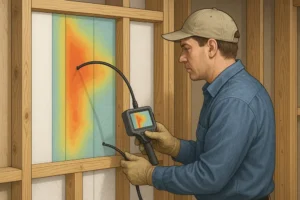
Thermal imaging performed days after the fire can’t reconstruct the slab’s peak fire temperature. It may identify current moisture, air leakage, or temperature differences, but it isn’t a historical thermometer.
Representative samples should then be collected from the affected area, a less-affected area, and a genuinely unaffected control when one exists. A field blank helps identify contamination introduced by the swab, solvent, container, or sampling process. If insurance disputes, litigation, or fire-cause questions are possible, chain of custody and coordination with the fire investigator may be necessary before the countertop is altered.
Next comes a controlled cleaning test, not a gallon of mystery degreaser and enthusiastic improvisation. The test area should use the exact manufacturer’s approved procedure when possible, with documented cleaner concentration, dwell time, agitation, rinsing, and drying. White wipes can help show residue transfer.
Once the area is dry, the team compares color, gloss, texture, residue transfer, tackiness, and odor. Post-cleaning FTIR can then be compared with the original affected sample and the control. Depending on the loss, additional checks may include microscopy, colorimetry, gloss measurements, crack mapping, surface-hardness comparison, seam inspection, and examination of the underside.
Air, headspace, or chamber testing becomes reasonable when odor remains after cleaning, returns as the room warms, concentrates near a seam, or accompanies visible resin alteration. It’s also appropriate when occupants report symptoms near the area or when an objective occupancy or insurance decision requires emissions data.
When Cleaning Is Enough
Cleaning is the strongest option when the slab remains flat, stable, and free of cracks, pitting, tackiness, blistering, or delamination. The residue should behave like surface contamination rather than altered resin. A manufacturer-compatible cleaning test should restore appearance without creating a dull, smeared, bleached, or sticky area.
Post-cleaning FTIR should show that significant removable organic residue has been reduced or that the cleaned area approaches the unaffected control. Seams, edges, the underside, and adjacent cabinets also need to be free of unresolved contamination. If a persistent odor remains, the job isn’t finished simply because the polished face passes a white-cloth test.
Clearance language should match the work performed. “No significant removable residue detected under the stated test conditions” is defensible when supported by the data. “Toxin-free” is an absolute claim that a limited countertop investigation can’t support.
Should Fire-Hit Quartz Be Sealed?
Engineered quartz generally doesn’t require routine stone sealer. Its resin-bound surface isn’t the same as porous granite or unsealed marble, and some manufacturers advise against conventional sealers. Applying a random coating after a fire can change gloss, color, texture, stain resistance, cleaning requirements, and warranty coverage.
A coating may be considered in an unusual restoration plan, but it shouldn’t be used to bury removable soot or conceal failing resin. Before application, the contractor needs to establish that the slab is physically sound, the coating is compatible with the exact product, and adhesion has been tested. The coating’s intended use, dry-film thickness, durability, maintenance restrictions, and suitability for a food-preparation surface also need review.
“Seal in the smell” isn’t a technical specification. A coating may temporarily change odor transmission while leaving active emissions, trapped residue, contaminated seams, or heat-damaged cabinets untouched. If the proposed system hasn’t been evaluated for that substrate and use, replacement may be the more predictable option.
When Replacement Makes More Sense
Cracking, warping, blistering, spalling, tackiness, severe discoloration, or loss of aggregate-to-resin bond strongly supports replacement. Failed seams and distorted edges are also warning signs, particularly when they occur near the main heat source.
Replacement becomes harder to argue against when odor has been traced to the slab or seam material and remains after appropriate cleaning. The same applies when direct testing confirms continuing emissions, contamination extends into inaccessible cracks or interfaces, or laboratory comparison shows substantial resin alteration.
Sometimes the quartz itself isn’t the deciding issue. Heavily contaminated cabinets may need to be removed, and a bonded slab may not survive that work intact. A technically salvageable countertop isn’t very useful if removing it to reach the cabinet substrate will crack it at the sink cutout.
Cost and uncertainty belong in the decision as well. Repeated sampling, destructive analysis, custom coating development, cabinet access, and multiple rounds of clearance testing can cost more than replacement while producing a less reliable result. Saving material is worthwhile when the evidence supports it, not when everyone is simply afraid to admit the slab is done.
Don’t Ignore the Cabinets Below
Cabinet interiors and the underside of the countertop are frequent blind spots. Particleboard, plywood, unfinished wood, laminates, coatings, and drawer components can collect soot and odor. Suppression water may also swell or weaken the substrate while leaving the stone surface looking respectable.
The inspection should include accessible cabinet cavities, sink-base openings, cooktop cutouts, backsplash interfaces, seam locations, and penetrations for plumbing or appliances. If odor is strongest inside a cabinet, source-oriented sampling near that cavity may be more useful than one general room-air sample taken across the kitchen.
Removal work also creates a separate safety issue. Installed, intact quartz isn’t the same exposure condition as cutting or grinding it. Dry sanding, sawing, drilling, or destructive sampling can release respirable crystalline silica. The OSHA and NIOSH countertop silica hazard alert covers controls used during countertop fabrication and installation. Restoration workers shouldn’t dry-grind smoke staining off engineered stone as an improvised cleaning method.
Frequently Asked Questions
Can Soot Permanently Stain White Quartz?
Yes, but not every dark mark is permanent. Oily smoke can discolor light resin, especially after heat exposure or improper chemical use. A controlled cleaning test followed by color, gloss, and residue comparison helps distinguish removable soot from altered or stained binder.
Can Quartz Release Odors After Heating?
It can, but the slab isn’t automatically the source. Heat-altered resin, seam adhesive, caulk, backsplash mastic, cabinets, and deposited smoke compounds may all contribute. Quartz binder off-gassing should be evaluated with targeted air, headspace, chamber, or gas-phase testing rather than assumed from odor alone.
Does FTIR Detect VOCs?
Gas-phase FTIR can detect certain vapor-phase compounds when the equipment, calibration, concentration, and sampling conditions are suitable. Standard ATR-FTIR residue analysis examines a solid or surface sample and doesn’t directly measure VOC concentrations in room air.
Can a Countertop Look Clean but Still Smell?
Yes. Odor-causing compounds may remain in seams, adhesive, caulk, the unpolished underside, or cabinets beneath the slab. Visual cleanliness and odor-source control are related, but they aren’t the same test.
Does Quartz Need Sealer After Smoke Damage?
Usually not. Engineered quartz typically doesn’t need conventional stone sealer. A specialized coating should only be considered after cleaning, compatibility testing, adhesion testing, manufacturer review, and evaluation of food-contact and warranty concerns.
Can Bleach Remove Fire Soot From Quartz?
Bleach isn’t a universal quartz cleaner, and it may fail to remove oily soot while altering the finish or complicating laboratory evidence. Cleaning should follow the exact manufacturer’s guidance and begin with a small, documented test area.
Can Cracked Fire-Exposed Quartz Be Repaired?
Some minor chips or isolated damage can be repaired cosmetically, but a fire-related crack may indicate heat stress, bond loss, or substrate movement. Repair shouldn’t be selected until the crack’s extent, stability, location, and cause are evaluated.
Who Should Interpret FTIR and Air Results?
A qualified analytical laboratory should interpret FTIR spectra, while an experienced industrial hygienist should design and evaluate indoor-air or emissions sampling. The restoration contractor then uses those findings alongside physical condition, manufacturer guidance, access, and cleanability.
Can Quartz Be Reused With New Cabinets?
Sometimes. The slab must be physically sound and removable without unacceptable damage. Sink cutouts, cooktop openings, long spans, seams, and strong adhesive bonds increase breakage risk. The underside should also be inspected before reuse over clean cabinets.
Is Dry Sanding Safe on Engineered Quartz?
No restoration contractor should casually dry-sand engineered quartz. Sanding can release respirable silica dust and may permanently alter the finish while driving residue into damaged areas. Any destructive work requires suitable dust controls, work practices, and respiratory protection.
A credible countertop decision combines inspection, product identification, controlled cleaning, FTIR residue analysis, seam and substrate evaluation, and direct emissions testing when quartz binder off-gassing is suspected. If you’re dealing with a fire-damaged kitchen, All Nation Restoration can assess the installation and help coordinate a testing plan that answers the real question: what can be cleaned responsibly, and what needs to come out?