If you park a cozy area rug on a concrete slab and pair it with a non-breathable pad, you just built a mini greenhouse for mold. I own a restoration company, and I’ve peeled up plenty of “perfectly fine” rugs to find a cool, damp slab, a slimy film on the backing, and that unmistakable locker-room funk. You don’t have to live with that. Here’s how to spot slab vapor issues early, dry things fast, pick breathable rug pads that won’t trap moisture, run simple slab moisture testing, and know when it’s time to tag a pro in.
Why Rugs On Concrete Go Musty
Concrete looks solid, but it’s a giant sponge that always wants to equalize with its environment. If there isn’t a proper vapor barrier beneath the slab, or groundwater and humid soil keep feeding it, the slab can push water vapor upward. Even newer slabs can give off vapor for months. The surface might look dry, but once you lay a rug and a dense pad on top, you create a lid that slows evaporation. Trapped vapor condenses, the rug backing stays damp, and microscopic mold spores say thank you and get busy.
When that moisture build-up has no path to breathe, you start noticing musty odor, a tacky feel on the slab or pad, discoloration on the rug backing, or slow breakdown of adhesives. Hidden mold under carpet and padding is a classic problem we see all the time. All Nation Restoration calls this out on our Hidden Mold Check page because soft furnishings are fantastic at concealing trouble beneath the pretty side you vacuum. You can read more here: Hidden Mold Check. If you want a nerdy building-science take on why concrete breathes vapor, here’s a good primer: Moisture Through Concrete Slab.
Quick Checks You Can Do Today
Start with your nose. If the rug smells musty where it sits on concrete but not when you lift it and smell the pile, the moisture is probably below. Slide a hand under a corner and feel the pad and slab. If they feel cool and slightly tacky compared to nearby bare slab, moisture is hanging out there. Press a dry white paper towel on the slab for sixty seconds. If it darkens or picks up a musty tint, you’ve got active moisture. Check the rug backing for wavy textures, sticky residue, or tiny dark specks. Look along exterior walls, at slab cracks, near sliding doors, and in basement or on-grade rooms that see seasonal humidity swings. Those are greatest hits for under-rug dampness.
If you discover dampness, stop the trap effect right away. Lift the rug and pad, stand them on edge with airflow around both sides, and run fans plus a dehumidifier. Concrete does not respond well to heat blasts alone, so aim for steady air movement and dry indoor air. Drying within 24 to 48 hours is the target window that shuts mold down before it takes hold. That timing lines up with the general mold growth rule of thumb we talk about in wet spaces and steam showers too. For context on preventing mold through fast drying, check our article here: Stop Mold In Steam Showers.
Fast Drying That Actually Works
Think of this as a two-part job: dry the soft stuff and dry the slab surface. Elevate the rug on something that lets both sides breathe. A clean picnic table or stack of plastic chairs works in a pinch. If the rug is heavy, roll it loosely like a jelly roll so air can move through the core. Put a box fan at one end and a dehumidifier in the same room set to 40 to 50 percent relative humidity. Rotate the rug every few hours until both the face and backing are dry to the touch and odor-free. For the slab, wipe any visible condensation, then keep airflow moving across the bare surface while the dehumidifier runs. Concrete may feel dry on top before the moisture inside stabilizes. Give it a full day or two and re-check with the paper towel test before you re-lay anything.
Skip bleach on rugs or pads. It can damage fibers and doesn’t fix vapor pushing through the slab. If you see visible mold on the pad or backing, plan to replace the pad and clean the rug using a method that won’t saturate it again. Hot water extraction is fine if the rug dries fast afterward. If a fine rug is involved, send it to a professional rug cleaner who will dry it under controlled conditions.
What Makes A Rug Pad Breathable
The right pad gives your rug grip and cushion without sealing the slab like Tupperware. Breathable rug pads allow air and vapor to move through so you don’t trap moisture under the rug. Look for a pad that has real vent paths and does not have a slick, impermeable film on the bottom. Needle-punched felt pads without waterproof backings are a better bet than dense foam. Natural rubber waffle pads create air channels and hold rugs steady without gluing them to the slab. Some hybrid felt and natural rubber pads use a dotted or grid underside that improves airflow. What you want to avoid are thick closed-cell foams, memory foam blocks, and vinyl or rubber pads with a solid, non-vented skin. Those trap vapor and create the sweatbox you’re trying to prevent.
Here’s a quick comparison to help you shop without getting tricked by buzzwords.
| Pad Type | Breathability | Pros | Watch-Outs | Typical Use |
|---|---|---|---|---|
| Needle-Punched Felt | Moderate to good | Cushion, stable under heavy rugs, often affordable | Can hold some moisture if slab is very damp, avoid versions with impermeable bottom coats | Living rooms, bedrooms on slab that tests reasonably dry |
| Natural Rubber Waffle | Good to excellent | Air channels, solid grip, thin profile that reduces trap effect | Low-quality rubber can mark floors, confirm it is natural and non-staining | Halls, entry runners, thinner rugs on slab |
| Hybrid Felt + Rubber Grid | Good | Blend of cushion and venting, often stable on concrete | Some hybrids use dense backings that reduce airflow, check the underside design | Family rooms where comfort and breathability both matter |
| Closed-Cell Foam or Memory Foam | Poor | Soft feel | Traps vapor, can create odor and backing breakdown on slab | Avoid on slab unless slab moisture is fully controlled |
| Vinyl or Rubber With Solid Skin | Poor | Strong grip, easy to wipe | Acts like a vapor barrier under the rug, promotes condensation | Avoid on slab under area rugs |
The general idea is simple: if you can see or feel open texture and channels in the pad, you’re on the right track. This is the same logic behind raised-channel subfloors that let concrete breathe. Systems like DryBarrier are a flooring example of that air-gap thinking that helps vapor disperse. You can learn more about that concept here: DryBarrier Subfloor. You’re not building a subfloor for an area rug, but you want the same principle in miniature.
Slab Moisture Testing 101
If you keep getting musty rugs or you’re about to put down a thick rug with a cushy pad on concrete, do slab moisture testing first. There are three common ways to understand what the slab is doing. Two are standardized methods typically used by flooring pros, and one is a simple screening check you can do yourself.
ASTM F2170 uses in-situ relative humidity probes placed in holes drilled to a specific depth in the concrete. For a slab drying from one side, the probes sit at about 40 percent of the slab thickness. The holes are sealed and allowed to equilibrate, then you read the internal RH. Many flooring manufacturers want that internal RH to be under about 75 to 80 percent before installing moisture-sensitive materials. That threshold is a guideline, and each product has its own spec. You can read more about RH testing basics here: Concrete Testing Methods Guide.
ASTM F1869 is the calcium chloride test. It measures the moisture vapor emission rate from a known area of slab over 24 hours. The result is a number, usually in pounds of water per 1000 square feet per 24 hours. Many materials want a rate under about 3 to 5 pounds, but again it depends on the manufacturer. This test is more surface-focused than F2170. You’ll find a quick overview of the method here: Concrete Subfloor Moisture Testing.
Non-destructive impedance meters give instant surface readings that are excellent for screening and mapping wet zones. They do not replace the ASTM methods, but they’re helpful to see if your slab is behaving differently in certain rooms or seasons. Here’s a reference on that tool: Concrete Moisture Meters.
For a simple homeowner screening, tape a clear plastic sheet about 18 by 18 inches to the slab with an airtight seal and leave it 24 to 48 hours. If condensation forms or the slab under the plastic looks darker, you have vapor activity. This plastic sheet check is not a pass-fail standard. It only tells you that the slab is actively pushing vapor and your rug plan should account for that. If the plastic test fogs up and your rug keeps getting funky, get professional testing before you invest in pricey pads or textiles.
Matching Pads To Moisture Reality
If your slab tests dry or seasonally mild, use breathable rug pads under area rugs and give the slab a little breathing room. That means picking a pad with open texture and skipping waterproof backers. Leave a 1 to 2 inch gap between the rug edge and baseboards so air can sneak out the sides. If you love a thick pad, choose one with a vented design, not a solid foam block. Rotate the rug quarterly so the same zones are not suffocating the slab year-round.
If your slab shows elevated RH or high emission rates, or your simple plastic check fogs up quickly, address moisture before you layer textiles. That can look like running a dehumidifier during humid months, improving drainage outside, sealing obvious slab cracks, or installing a surface-applied moisture control coating that is rated for hydrostatic vapor. These coatings are not paint. Many are epoxy or urethane systems that require meticulous surface prep and are best installed by pros. In below-grade spaces with persistent vapor, you may need a raised subfloor system that includes an integrated air gap. Laying a barrier under a rug by itself usually backfires, because it just moves the condensation point around and still traps moisture somewhere it does damage.
When the slab is marginal but not extreme, you can sometimes make rugs work by combining three moves at once: a thin breathable pad, routine dehumidification, and strict rotation with periodic lift-and-dry checks. If those steps fail and musty odor returns fast, skip the rug in that spot or bring in testing to see what the slab is really doing.
Maintenance Habits That Keep Rugs Fresh
Concrete slab behavior shifts with seasons, rain patterns, and how you live in the home. A runner by a wet entry will cook up different problems than a thick shag in a basement movie room. Keep indoor humidity between 30 and 50 percent, and closer to 40 percent in summer if your climate allows. Use a hygrometer so you’re not guessing. Lift and inspect each rug on slab once per quarter, especially in warm wet months. If a pad feels clammy or smells off, don’t wait. Air it out and reset your dehumidifier. Clean spills right away so you’re not feeding microbes with a sugar or protein snack. Leave a little breathing gap at walls and around furniture feet so air can move. If you want a checklist that covers the usual moisture tripwires in a house, grab our free PDF here: Moisture Prevention Maintenance Checklist.
Consider where the sun hits. A sunny slab patch warms up and can drive vapor differently than a shaded one. If one corner of a rug keeps getting funky, slide the rug six inches and see if the issue follows the orientation or stays with the slab spot. That quick experiment can tell you a lot about whether the problem is pad choice or slab behavior.
When Should You Call A Pro?
If you keep getting musty odor under the same rug, or you see visible mold on the backing or pad, it’s time to stop guessing. If you test and see high RH or high emission rates, or you get condensation under the plastic sheet within a day, you’re not looking at a one-off spill. Other red flags include repeated pad deterioration, white mineral deposits on the slab, darkened carpet tack strips around rooms, and efflorescence lines along baseboards. Health symptoms that pop up when you spend time in one room and vanish elsewhere are also worth respecting. Here’s a quick primer on warning signs: Water Damage and Mold Signs.
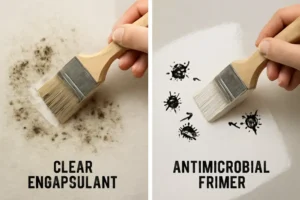
What we do on calls like this is pretty straightforward. We map moisture with non-destructive meters, use thermal imaging to find cold damp zones, and run proper slab moisture testing where it makes sense. If we find hidden growth in padding or under tack strips, we remove contaminated materials safely, clean and dry the slab, and apply appropriate antimicrobial treatments after physical removal. When the slab itself is the driver, we coordinate with installers on breathable pad choices and, if needed, recommend or apply surface moisture control systems that match the test results and the intended floor covering. The goal is not to force a rug to live where physics will not cooperate. It’s to make smart choices that keep textiles from becoming permanent science projects.
Real-World Rug Cases
Case 1: Basement movie room on a 1990s slab. Thick felt pad under a plush 9 by 12. Family calls because the room smells musty three weeks after professional rug cleaning. We lift a corner, the slab feels cool and tacky, and the pad is lightly spotted. Plastic sheet test fogs noticeably in 24 hours. We dry the rug offsite, replace the pad with a thinner hybrid felt and rubber grid, install a dehumidifier set to 45 percent, and switch the layout so the rug leaves a 2 inch gap at walls. Odor gone. We re-check at 30 and 90 days. The slab still breathes a little in summer, so we coach them on quarterly lift checks.
Case 2: Entry hall runner over an on-grade slab with a west-facing door. Cheap vinyl pad with a solid underside. The runner keeps getting wavy and sticky. We find the pad acting like a barrier and condensation pooling under the vinyl. We swap to a natural rubber waffle pad and add a boot tray for wet days. Problem solved. Sometimes the fix is as simple as not turning your hallway into a terrarium.
Case 3: Bedroom area rug where the family dog likes to nap on hot afternoons. Pad was a dense foam block. The slab is modestly humid in summer and the dog is basically a moisture source with paws. We replace the pad with a breathable felt, set a small dehumidifier to run June through September, and move the rug six inches off the exterior wall to let air move along the baseboard line. No more odor. The dog still naps. That part we do not fix.
FAQ: Quick Answers
Do breathable rug pads really matter on concrete?
Yes. Breathable rug pads reduce the trap effect so vapor has a path to disperse. They are not magic if your slab is wet, but they dramatically lower the risk of condensation at the rug-slab interface when the slab is within normal ranges.
Can I just seal the slab with paint and call it a day?
No. Paint is not a moisture control system. If you need a sealer, you need one that is rated for moisture vapor control on concrete, and surface prep is the whole ballgame. That kind of work is best guided by testing and installed by someone who does it often.
What’s an acceptable slab RH for rugs and pads?
There is no single number for rugs the way there is for many floor finishes, but using flooring guidance is smart. Many floor coverings want in-situ RH under about 75 to 80 percent. If your slab is in that zone and you use breathable rug pads, you’re generally in safe territory.
Will a dehumidifier fix a damp slab by itself?
It helps a lot, especially in summer, because lower indoor RH makes it easier for moisture to leave the slab without condensing under a rug. If groundwater or a missing vapor barrier is the culprit, dehumidification is part of the plan, not the whole plan.
How often should I lift and check rugs on slab?
Quarterly is a good rhythm, with bonus checks after big rain events or during your stickiest months. If a rug is in a known trouble spot, check monthly until you understand the seasonal pattern in your home.
Next Steps If You’re Dealing With Odor Right Now
Lift the rug and pad today and let them breathe. Set a dehumidifier to 40 to 50 percent and run a fan across the slab. If the paper towel test shows dampness after 24 hours of airflow, hold off on reinstalling until it stabilizes. When you do reset the rug, use a breathable pad and leave a small perimeter gap so air can escape. If the smell returns, or you want real numbers before you buy new pads, schedule slab moisture testing. If you’re in our service area, we can handle the testing, drying, and pad guidance. If not, look for a restoration or flooring pro who speaks the language of ASTM F2170 and F1869 and understands how breathable rug pads and slab moisture testing work together.