Eco is great when we’re talking about dish soap or craft beer. On your thermostat, it can be the start of a fuzzy science project in your closet. If your smart thermostat eco mode leans on fat temperature setbacks and fan-only “circulation,” you might be spiking indoor humidity and spraying moisture back into your rooms from a wet evaporator coil. That stunt has a name in the HVAC world: coil re-evaporation. It is a fast track to musty smells, sweaty walls, and mold colonizing quiet corners behind dressers and inside closets. I restore homes for a living, and I love saving energy, but not at the price of a new spore farm. Here’s how to keep your savings and starve the mold.
What Is Coil Re-Evap?
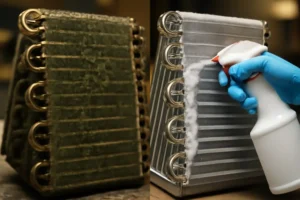
Air conditioning does two jobs at once: it cools the air and it dehumidifies it. As warm, humid air passes over a cold evaporator coil, water condenses on the metal fins and drips into a drain pan. That’s the part you want. Coil re-evaporation is the part you don’t. When the compressor stops and the fan keeps blowing, the coil warms up, the water sitting on it hasn’t fully drained yet, and the fan literally atomizes and launches that moisture right back into your house. Your thermostat reads a cool-enough temperature, but your relative humidity jumps like a cat on a countertop. You feel clammy, your AC runs weirdly, and microclimates in closets and corners hit condensation levels that mold loves.
Humidity spikes like this are common right after a cooling cycle ends and during eco setbacks that shorten compressor runtime. Less runtime means a warmer coil and more leftover moisture. If your fan is set to On or your thermostat forces fan-only circulation, you’re basically turning your AC into a humidifier for a couple of minutes after every cycle. That re-evap spits moisture into rooms and ducts, then parks it onto cold surfaces, paper, cardboard, or clothing. Mold doesn’t need much more than that and 24 to 48 hours of steady moisture to get established source.
How Eco Modes Spike Humidity
Smart thermostats win their energy trophies by using wider deadbands, deeper setbacks, shorter cycles, and fan-only circulation tricks. Great in a dry climate. In muggy regions, those moves can go sideways.
Here’s the usual chain reaction. You bump the setpoint up 5 to 8 degrees while you’re away. The AC runs less, so the coil never stays cold long enough to wring out much moisture. Then the schedule hits a fan-only circulation hour to “mix air” or “filter dust.” That fan blows over a wet coil and sends a misty plume into your supply ducts. Your thermostat’s temperature display still looks fine, but your closet RH jumps from 50 percent to 65 percent. Two days later the corner behind your dresser smells like a wet dog in a wool sweater.
Another backfire shows up with always-on blower fans. People run the fan for filtration or because someone told them it “evens out temperatures.” It can even out moisture too, in the wrong direction. With the compressor off, that fan keeps stripping water off the coil. That’s textbook coil re-evaporation, and it’s a repeatable way to grow mold in return grills, closets, and low-airflow rooms source.
Thermostat Settings That Actually Help
You don’t have to treat your thermostat like a gremlin. Give it the right rules and it will keep you comfortable without feeding mold.
Set The Fan To Auto
Fan set to Auto means the blower only runs when the compressor runs. Set to On means it runs continuously, including over a wet coil after cooling stops. Auto is the safer default in humid weather. If your thermostat has a “Circulate X minutes per hour” feature, use it sparingly from late morning through night during humid seasons. If you want circulation for filtration, schedule those circulation windows when the system is likely to be actively cooling so the coil is cold and draining.
Disable Post-Cool Fan Run
Some thermostats run the blower for a minute or two after cooling to scavenge “leftover cold.” Nice on paper. In reality, it often re-evaporates water off the coil. If your model supports a setting like Ecobee’s Cool Dissipation Time, set it short or off so the blower stops as soon as cooling ends. That keeps condensate on the coil and in the pan until it drains instead of in your linen closet source.
Turn On Dehumidify With AC
Many smart thermostats let you set a humidity target and allow slight “overcool” to hit it. If yours has Dehumidify setpoint and AC Overcool Max, use them. A 1 to 2 degree overcool allowance can pull down RH without turning your living room into a meat locker. Example: set temperature to 75 and dehumidify to 50 percent with up to 2 degrees of overcool. The thermostat will keep the coil cold a bit longer, condense more water, and let it drain before shutting both compressor and fan. This reduces those rebound humidity spikes that make rooms feel swampy source.
Target The Right Humidity
Keep indoor RH between 30 and 50 percent most of the year. In hot-humid seasons, 45 to 50 percent is realistic for many homes with standard AC. In cold months, 35 to 45 percent helps avoid window condensation and drywall sweating. If your home sits above 55 percent RH for hours each day, nudge your dehumidify setting down or add a dehumidifier. Mold tends to take hold fast when moisture is persistent and surfaces stay cool source.
Rethink Eco Setbacks
Deep setbacks cut runtime too much in humid weather. The coil never spends enough sustained time below dew point, so less water is wrung out. Try smaller setbacks during sticky months. Instead of raising the setpoint 7 or 8 degrees while you’re at work, try 2 to 3 degrees. You still save, and you keep the moisture-removal engine from stalling out.
Ventilation And House Tweaks
Thermostat settings can only do so much if your home is feeding moisture into little pockets and then trapping it there. Mold loves stale air and cold surfaces.
Start with airflow. Closets need to breathe. Louvered doors, a 3/4 inch undercut at the bottom, or simply leaving doors cracked during the day helps. Don’t press dressers tight to exterior walls. Give an inch or two of air gap so the wall can warm and any dew point magic stays out of the equation. Behind couches and big cabinets is another moldy blind spot. A small gap and periodic airflow are cheap insurance source.
Use exhaust fans where moisture is born. Bathrooms and kitchens pump out water vapor like crazy. Run bath fans during and for 20 minutes after showers. Use your range hood whenever you boil or simmer. In basements, laundry rooms, and rooms over crawlspaces, consider a dedicated dehumidifier. AC can do some of the job, but in shoulder seasons and during light cooling loads, a real dehumidifier does the heavy lifting far more efficiently.
Seal and insulate. Leaky rim joists and attic hatches can bring in humid outside air that condenses on cold drywall or ductwork. Weatherstripping and attic insulation aren’t glamorous, but they keep surfaces warmer and cut condensation zones. Bonus points for sealing duct leaks so you’re not sucking crawlspace funk into your returns.
Safe Schedules You Can Copy
Every house is different, but you can start with templates that prioritize humidity control first and temperature second in sticky months. Then tweak by watching your RH at peak times: mid-afternoon, right after bedtime, and early morning.
| Time | Cooling Setpoint | Dehum Target | Overcool Max | Fan | Notes |
|---|---|---|---|---|---|
| 6 a.m. to 9 a.m. | 74 to 75 | 50% | 1 to 2°F | Auto | Morning showers mean more humidity. Keep overcool on. |
| 9 a.m. to 5 p.m. (Away) | 77 to 78 | 50% | 1°F | Auto | Small setback. No fan-only circulation in humid months. |
| 5 p.m. to 10 p.m. | 74 to 75 | 50% | 2°F | Auto | Prime humidity time. Let AC run long to dry coil and drain. |
| 10 p.m. to 6 a.m. | 73 to 74 | 48 to 50% | 1 to 2°F | Auto | Doors cracked for closet airflow. No circulation-only cycles. |
Live in a dry climate? You can push away setpoints 4 to 6 degrees and use short circulate periods. But still disable post-cool fan runs and monitor RH, because even deserts have monsoon days.
Have a variable-speed system? You’re already ahead on humidity control, but the same rules apply. Avoid long fan-only periods. Keep a modest overcool allowance active. Make sure the installer configured dehumidify with either compressor speed reduction or reheat if available.
Stop Seeding Mold In Closets And Corners
If your closets smell musty, look for these usual suspects. Doors are closed all day and there’s no return vent in that room. There’s a dresser or bookshelf pressed against an exterior wall. The HVAC fan runs after cooling, or the thermostat circulates air without cooling in the afternoon. The bath fan is used for five minutes instead of twenty. Add in an aquarium, a jungle of houseplants, or a pile of damp towels, and you’ve built a mold playground. Start by opening the space to airflow, cutting the fan shenanigans, and targeting 45 to 50 percent RH. If that still doesn’t fix it, a small in-closet grille to the room, a louvered door, or a jump duct can balance airflow and eliminate that stagnant pocket.
Monitoring That Actually Catches Problems
What you don’t monitor will bite you. Your thermostat has a humidity sensor, but it only sees one spot. Add a couple of cheap hygrometers to closets and far bedrooms. Calibrate them if possible, then compare readings during the muggiest time of day. If you see a 10 point higher RH in a closet than in the hallway, you’ve found a ventilation or cold-surface issue.
Pay attention right after the AC stops. If your hallway RH bumps up a few points and then slowly drifts down, that’s normal-ish. If it jumps 5 to 10 points and stays high, you likely have either post-cool fan run, a fan set to On, or a coil that’s not draining efficiently. Adjust settings first. If the spike sticks around, have the HVAC tech check coil cleanliness, drain pan slope, and the condensate trap.
Maintenance That Keeps Coils Dry
Clean coils move heat and shed water. Dirty coils are sponges. Replace filters on schedule, and do not upsize to a super restrictive filter without confirming your blower can handle the pressure. Have the evaporator coil cleaned as needed, especially if you see reduced cooling, icing, or weak airflow. Clear the condensate drain and trap at the start of each cooling season. Make sure the drain pan isn’t cracked and that the line is properly sloped. If your system sweats on the outside of ducts, you’re probably pulling humid air into a hot attic or crawlspace and running it over a cold metal tube. Seal and insulate those ducts so you don’t end up with soggy insulation and hidden mold in the boot.
When You Need More Than Settings
Sometimes the thermostat is doing its best and the weather still wins. If your home sits at 55 to 60 percent RH for long stretches in summer even with good AC settings, add a dehumidifier. A whole-house unit paired to your return duct and controlled by the thermostat is the gold standard, because it can dry the air without overcooling the house. Portable units work too if you focus on the rooms that spike first.
Look for other moisture sources. Crawlspace soil that is uncovered or vented into humid air will steam-bath your subfloor. Wet foundation walls, plumbing leaks, unvented dryers and gas appliances, and poorly vented attic bathrooms are all mold accelerators. Mold begins to develop in 24 to 48 hours when materials stay damp, so quick fixes and dry-outs matter source.
Quick Fixes For Common Thermostats
Every brand hides these controls in different menus, but the ideas are the same.
Ecobee. Set Fan to Auto. Under installation settings, set Cool Dissipation Time to the shortest option or Off. Enable Dehumidify with AC, set 50 percent RH target, and allow 1 to 2 degrees of AC overcool source.
Nest and similar learning stats. Avoid aggressive eco setbacks in humid months. Turn off fan-only schedules. If there’s a dehumidify option, use it with a small overcool allowance. If not, set smaller temperature setbacks so cycles run long enough to dehumidify.
Honeywell and others. Disable residual cool fan, post-purge, or fan circulation features during humid seasons. If your model supports Dehumidification Control or has a separate dehumidifier terminal, wire and enable it so the thermostat can run dehumidification independently of cooling.
FAQ: Fixing Humidity Without Wrecking Comfort
Is fan-only circulation really that bad in summer?
Used in short bursts while the coil is dry, it’s fine. Used right after cooling or for many minutes each hour, it tends to re-evaporate water off the coil and raise indoor RH. In humid months, limit or disable it.
Should I just set my thermostat way lower to dry the air?
No. Overcooling more than 2 degrees costs you comfort and electricity without much extra moisture removal. Use a dehumidify setting or a dehumidifier to control RH without turning your home into a penguin exhibit.
Can I run the fan constantly to filter air?
Not with a standard AC system in humid weather. Constant fan plus a wet coil equals coil re-evaporation. If filtration is a priority, use Auto and a good filter, add an in-room purifier, or have your HVAC contractor configure a system that can run the fan with active dehumidification.
Why does mold pick closets and corners?
Low airflow plus cool external walls and plenty of cellulose. Relative humidity in those pockets can be 10 points higher than the hallway. Add fan-only re-evap moisture, and you have perfect conditions for colonies to start on cardboard boxes, leather, and drywall paper.
What humidity number should I actually aim for?
Target 35 to 50 percent RH through the year. In summer, 45 to 50 percent is a solid goal. In winter, pull back to 35 to 45 percent to avoid condensation on windows and cold walls.
How do I know if coil re-evaporation is happening?
Watch humidity during and after a cooling cycle. If RH rises a few minutes after the compressor stops and the fan keeps running, you’re likely re-evaporating. Check your fan mode, disable post-cool fan run, and verify the condensate is actually draining.
Mold-Proofing Moves That Cost Almost Nothing
Crack closet doors during the day. Leave a 1 to 2 inch gap behind big furniture. Run bath and kitchen exhausts long enough to clear steam. Keep the HVAC fan set to Auto. Disable any “fan after cooling” settings. Use a 1 to 2 degree overcool allowance with a 45 to 50 percent RH target. Make sure supply vents are open in closets and low-airflow rooms. If you’re still sticky, add a dehumidifier before you add regrets.
When To Call A Pro
If you’re battling recurring musty odors, RH won’t dip below 55 percent, or you see growth inside supply registers, get a qualified HVAC tech and a mold remediation team involved. Coils and drain pans can harbor growth if cleaning and drainage are neglected source. We’ll check the system, find the moisture source, and actually dry hidden spaces instead of just perfuming them. If your smart thermostat eco mode is saving a buck while costing your health, it’s time to fix the settings and the building.
Want help setting a humidity-safe schedule, cleaning a swampy coil, or evicting the fuzz from your closets? That’s literally what my crew does. We love saving energy, but we love dry walls and clean lungs more. Reach out and we’ll make your eco mode work for you, not for mold.