Do those blackened windows need to be torn out, or can you clean off the soot? Fire-damaged windows don’t automatically require replacement. If the residue sits on accessible surfaces and the assembly remains sound, professional soot cleanup may be enough for your window.
The deciding factor is physical damage. Soot is surface contamination, while cracked glass or permanent frame distortion means your window no longer performs as designed.
Don’t touch loose glazing or force a stuck sash to find out which problem you have. The U.S. Fire Administration’s post-fire guidance recommends waiting until authorities have declared your property safe to enter. Photograph the window before anyone cleans or removes it.
Soot Does Not Prove Heat Damage
Heavy soot can make your intact glass look scorched beyond repair. Darkening on the room-side glass may come from smoke residue deposited during the fire. Discoloration on a vinyl or metal frame can be surface contamination too, so you shouldn’t assume the material melted or burned based on color alone.
You’ll learn more from a controlled test cleaning than from an aggressive scrub. Professional fire-restoration methods account for the residue and the surface beneath it, principles addressed by the ANSI/IICRC S700 standard. If you scrape coated glass or attack a finished frame with an abrasive pad, you can create damage that wasn’t there before.
Locate the Haze Before Judging the Seal
If you can reach the film from the room or exterior, you’re probably looking at surface residue. A restoration professional can test a small area to determine whether the darkening lifts without harming the finish.
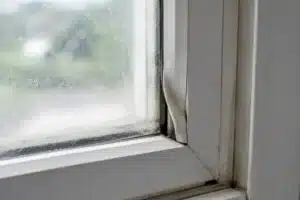
Fog trapped between two panes points to a different problem. Your insulated windows use panes separated by a sealed space. The Department of Energy’s window overview explains how this construction limits heat transfer. Cleaning the exposed glass won’t repair a damaged perimeter seal inside the assembly.
Visible moisture doesn’t automatically prove that your insulated glass seal failed. Room-side condensation may result from indoor humidity meeting a cold surface, as the National Fenestration Rating Council explains. Look closely at where the moisture is located. If it’s sealed between the panes and you can’t reach it from either side, your glass unit needs professional evaluation.
Signs That Justify Replacement
Replacement becomes justified when heat has altered the glass or its supporting components. You may need to replace only the failed part, but severe damage to your frame can make full-window replacement the practical choice.
Cracked or Loose Glass
You should treat a post-fire crack as damage even if the pane remains upright. An edge chip or visible displacement also deserves evaluation by a qualified glass professional. Keep people away from the area, and don’t press on the pane or operate the sash to see if it holds.
Warped Frames and Sashes
Unbroken glass doesn’t prove that the rest of your window survived. Your vinyl frame may ripple or separate at welded corners. Wood can char around the glazing stops, while a metal frame may distort enough to keep the sash from sitting evenly.
Damaged Gaskets and Retainers
When you inspect heat-damaged seals, focus on the visible gaskets and sealant around the glass. Shrinkage or melting is a clear concern. If a gasket has hardened or pulled away, it can’t maintain consistent contact. A distorted glazing bead may no longer support your pane correctly.
Failed Insulated Glass Seals
If you find between-pane fogging after a fire, your insulated glass seal may have failed. Deposits inside the cavity deserve the same attention. When the surrounding sash remains square, a contractor may be able to replace your insulated glass unit without removing the entire frame.
Loss of Normal Operation
Your window should close fully and lock normally once it has been cleared for testing. Binding or a sash that won’t remain closed suggests damage. Give a bedroom escape window extra attention because local code controls its required operation, and confirm the applicable requirements with your local authority.
Movement Around the Opening
A new sash won’t solve an opening that has moved. Check for a permanent gap beside the frame or burned support around the sill. If your surrounding wall is out of square, have that condition evaluated before you order replacement parts.
Signs Professional Cleanup May Be Enough
Your intact window is a reasonable candidate for professional soot removal when all of the following conditions are present:
- The glass has no cracks or loose edges.
- The frame and sash remain square.
- The window closes fully and locks without force.
- Gaskets and glazing retainers stay seated.
- No haze or deposits are trapped between panes.
- Residue is limited to accessible surfaces.
- A test cleaning reveals no hidden heat damage.
Use this as a screening checklist, not as permission to handle unstable glass. If the pane moves in its frame or the sash is stuck, stop testing. In our opinion, professional cleanup is far cheaper than turning your questionable pane into a floor full of broken glass.
The Whole Window May Not Need to Go
You don’t have to treat window replacement as an all-or-nothing decision. A failed insulated glass unit may be replaceable while your sash and frame remain. You can sometimes replace a damaged gasket or operator as a separate component, provided compatible parts are available.
More extensive replacement makes sense when your sash is permanently bowed or the frame can’t retain the glass securely. Full replacement is also likely when charring has removed support material or you can’t adjust the window enough to seal against weather.
Include the surrounding wall in your decision. Firefighting water can enter gaps around a damaged opening and wet the materials below. If that happened at your property, include the area in an assessment for water damage restoration in Austin before you close the wall around a replacement window.
Recheck Everything After Soot Removal
Soot can hide fine cracks or small gaps around your glazing stops. Once professional cleaning exposes the substrate, take another look at the pane edges and sash alignment. Check whether the sash contacts its weatherstripping evenly, then watch for fog returning between the panes. If you repaint dark trim or caulk over residue before this second inspection, you’ll conceal evidence you still need.
Decide What You Can Safely Do
Your safe DIY role is usually limited to taking photographs and observing where residue appears. Leave the window alone if its glass or frame shows physical damage. Heavy soot on coated glass belongs with a professional because the wrong pad or chemical can permanently mark your window.
At All Nation Restoration, we separate accessible soot from assembly damage before recommending your next step. Here’s the rule we use: if your window is stable and the issue appears confined to an exposed surface, start with a professional cleaning test. If the window or surrounding opening has changed, bring in restoration and window specialists before anyone disturbs it.
References
- U.S. Fire Administration’s post-fire guidance (usfa.fema.gov)
- S700 (iicrc.org)