If your sprinklers are blasting your siding like a car wash and your water bill looks like a ransom note, you might be slow-cooking a water damage disaster. Sprinkler overspray and sneaky irrigation leaks love to shove moisture into slabs, crawlspaces, and walls. Inside my world of restoration, I see it all the time: a head tilted 10 degrees or a hairline crack in a buried line turns into swollen baseboards, musty drywall, and mold that thinks your wall cavity is an all-you-can-eat buffet. The good news is you can head this off fast with a few sharp inspections and low-cost fixes aimed at foundation seepage prevention before the interior turns into a project you never budgeted for.
What Is Sprinkler Overspray & Why It Matters
Sprinkler overspray is when irrigation water hits anything except the turf or plants it’s meant to reach. That means spray patters splashing exterior walls, pounding the foundation line, or misting windows. Overspray usually happens because a head is misaligned, too tall or too short for the grade, running at too much pressure, or sporting the wrong nozzle arc. Wind drift and settled soil also tilt heads just enough to turn a lawn-friendly sprinkle into a wall-soaking problem.
Why it matters comes down to materials and physics. Exterior claddings are water resistant, not waterproof. Brick and mortar absorb water. Stucco has tiny cracks and joints. Siding and trim have seams. At the base of the wall there is a vulnerable intersection where the wall meets the slab or stem wall. Constant wetting saturates soil, raises hydrostatic pressure against the foundation, and lets water work into cracks, joints, and penetrations. Once water sneaks past the exterior, it wicks through porous materials and follows gravity to the low points inside your home. That is how an innocent sprinkler habit turns into discolored baseboards, cupped hardwoods, or fuzzy mold in the wall cavity.
There is also the silent teammate of overspray: underground irrigation leaks. When a lateral line or fitting is cracked near the house, it elevates moisture around the foundation 24-7. That wet soil presses on the slab or crawlspace walls until water finds a way in. Industry guidance connects misdirected spray and buried leaks directly to indoor moisture problems and structural stress. For a deeper primer on the link, see ServiceMaster’s overview on irrigation systems and indoor water damage and how leaks elevate soil moisture and pressure near foundations here.
How Underground Leaks Worsen The Problem
Underground irrigation lines fail for a bunch of unglamorous reasons: PVC glue joints age, poly lines get chewed or kinked, fittings crack during freeze-thaw, roots push on couplings, or a shovel handles them like a piñata. Many of these lines were trenched along perimeters where the soil is already looser. When a leak opens near your foundation, the water saturates the trench channel, then the adjacent backfill, and finally the native soil. That keeps the moisture right where you don’t want it.
In clay-heavy regions, soggy soil swells and puts extra pressure on concrete and masonry. As the area dries, the soil shrinks. Repeat this enough times and you stress the structure, widen existing cracks, and make a wetter path of least resistance. In slab-on-grade homes, water can intrude at cold joints, plumbing penetrations, or the slab edge where the stem wall meets the flatwork. In crawlspaces, leaks near piers or block walls drive up humidity, rot out sill plates and joists, and invite mold to colonize insulation facing and subflooring.
Signs of a buried leak include a constantly damp patch of lawn even in dry weather, turf that is suspiciously lush along a foundation line, standing water in a valve box, or a water meter that keeps spinning when every fixture is off. Robinson Plumbing provides a handy guide to leak detection steps like meter tests and zone isolation that any homeowner can try first. You can read more about irrigation leak detection basics here.
One more accelerant is overwatering. If the controller is set to long runtimes and frequent cycles, you have man-made rain driving water where gravity wants it to go. Irrigation pros warn that overwatering near the house multiplies foundation movement risks while softening soil that is supposed to support footings. Texas irrigation contractors have been waving this flag for years and connecting overwatering to foundation stress and indoor moisture problems. See an example from a Texas repair firm here.
Where Water Actually Gets In
Let’s ditch the mystery and talk about the doorways water uses to trespass. At the base of a wall, you have a cold joint where the slab edge meets the stem wall or grade beam. If that joint is exposed or the exterior grade lines up too high, water can seep through capillary action and gravity. Expansion joints between your driveway or patio and the foundation are another classic entry. If those joints have crumbled filler or no sealant, water pours into the gap, hugs the foundation wall, and finds its way indoors.
Utility penetrations are repeat offenders. Hose bibs, electrical conduits, AC linesets, and pest control ports all punch through the envelope. If those are not sealed with a long-life polyurethane or compatible sealant, they can act like tiny funnels.
Cladding adds its own paths. Brick veneer has weep holes and mortar joints that breathe. If overspray drenches that zone daily, water bridges the cavity via mortar droppings or debris. That shows up as efflorescence on the face of the brick or dampness on the interior side. Stucco and fiber cement have laps and trim joints that open slightly under movement. Persistent wetting makes those gaps much better at pulling water into sheathing. In crawlspace homes, moisture pushes through foundation vents or wicks up through unsealed block cores, then hangs out in fiberglass batts like a sponge.
Warning Signs You Should Not Ignore
Outside, the easiest giveaway is a wet strip or algae line along the bottom 12 inches of your walls. Efflorescence looks like white crusty powder on brick or concrete. Paint or stain that keeps blistering at the same spot after every irrigation cycle is another red flag. Trim that looks swollen or soft, especially near hose bibs and corners, is usually holding water. You might also see rust on metal weep screeds or anchoring hardware near grade.
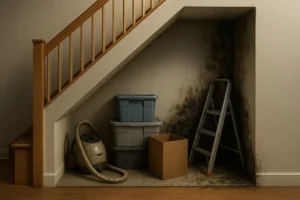
Inside, start at the baseboards. Press gently where furniture hides the wall. If the board moves, feels puffy, or the caulk line is curling, moisture has been visiting. Laminate and hardwood planks will cup or crown. Drywall tape may ripple, and there could be faint tan stains at the bottom corners of exterior walls. Musty odor is the smoke alarm of hidden moisture. If your crawlspace smells like a locker room and the floor insulation looks like it is sagging in hammocks, that is moisture loading the space.
If you own a hygrometer, watch indoor relative humidity. Rooms hovering above 60 percent RH for long stretches are not just uncomfortable. They are primed for fungal growth on paper-faced products. Once overspray or a line leak gets the wall wet, mold can start in as little as a day and a half in warm conditions. You are not going to smell it instantly, but the wall cavity will.
Inspect Yourself: Quick Homeowner Checklist
You do not need to be an irrigation tech to catch most sprinkler overspray problems early. Run each zone individually and stand where you can see the spray reach the house. Watch the first 30 seconds and the final 30 seconds. Heads that burp at shutdown often leak by with low-head drainage that pools at the lowest sprinkler near the home.
Check for spray hitting siding, windows, garage doors, and the exposed slab edge. If you see misting, the pressure is too high and you are vaporizing water that the wind can shove straight at your walls. If the soil right next to the foundation feels spongy, that is not a win. Pop a valve box lid. If you find water sitting in there without recent rain, a weeping valve or cracked fitting is begging for attention.
Grab a flashlight and peek into your crawlspace if you have one. Look for damp soil, condensation on ducts, or foggy plastic if there is a vapor barrier. Outside, find the expansion joint where the driveway meets the slab. If it is open or crumbling, water is using it like a drain. Last, try a simple meter test when all water is off. If the meter moves or the leak indicator spins, you have a hidden leak. Isolate the irrigation by closing the vacuum breaker or backflow preventer valves, then recheck the meter. If the spinning stops, the system or one of its zones is guilty.
| Symptom | What It Suggests | Next Step |
|---|---|---|
| Water hitting siding or slab edge | Sprinkler overspray or wrong nozzle arc | Re-aim heads and swap to tighter arc or short-range nozzle |
| Soggy strip along foundation | Overwatering or nearby line leak | Shorten runtimes and pressure-check the zone |
| High water bill, meter spins when off | Underground irrigation leak | Isolate irrigation and schedule leak locating |
| Efflorescence at brick base | Chronic wetting at veneer cavity | Reduce overspray, clear weeps, evaluate grading |
| Swollen baseboards, musty odor | Moisture intrusion in wall cavity | Moisture mapping and interior drying before repairs |
Fixes & Prevention Strategies That Work
Start with the fastest wins. Re-aim or level misaligned heads so the arc clears the wall. Trim grass that holds heads down. If the head is too close to the house, move it back or cap it and reconfigure the zone. Near foundations, swap spray heads for drip or micro-spray that targets plants without throwing water at the wall. Keep at least a 2 to 4 foot dry buffer along the foundation with rock or mulch designed to drain quickly, and avoid planting thirsty shrubs that need daily watering right against the house.
Right-size water output. If you see atomized mist, install pressure-regulated heads or a zone pressure regulator. Pick nozzles with the correct radius so you are not painting the wall every morning. Add check valves on low heads to stop low-head drainage that puddles at the base of the house after each cycle. Use a rain sensor or a modern smart controller so the system does not water on top of a thunderstorm. Program deeper, less frequent watering on turf farther from the home and keep runtimes short in zones near the perimeter.
Eliminate line leaks. If you suspect a buried problem, have an irrigation tech pressure-test the zones and locate breaks with acoustic or tracer methods. Replace cracked laterals and leaking valves, and bed new pipe with clean fill so rocks do not chew through later. If roots are prying on your lines, correct the route or shield the pipe rather than playing whack-a-root every summer.
Control surface water. Grade soil so it falls away from the house 6 inches over the first 10 feet where possible. Seal gaps at driveway and patio joints next to the foundation with backer rod and a polyurethane joint sealant rated for exterior movement. At wall penetrations, pull out brittle caulk and reseal with a high-quality, compatible sealant. Make sure downspouts discharge far from the foundation and do not soak the same zone your sprinklers are trying to manage. If you face chronic wetting even after adjustments, consider a French drain or surface drain that intercepts and routes water away from the slab edge.
Protect crawlspaces. If irrigation is raising humidity downstairs, install a continuous vapor barrier with overlapped and sealed seams and extend it up the interior of foundation walls where allowed. Air seal obvious openings and consider a crawlspace dehumidifier sized to the volume. Coordination matters here so the fix supports the overall design of the home and local code.
Seal the small stuff but do not count on sealant to defeat a bad watering pattern forever. Sealants and waterproofing help, but real foundation seepage prevention starts with not hammering the house with irrigation in the first place. Keep the water where the roots are and the structure will thank you by not turning your drywall to oatmeal.
Irrigation Myths That Wet Houses
Myth 1: Brick is waterproof so spray is harmless. Reality: brick and mortar are porous. Overspray drives moisture into the veneer cavity, and efflorescence is a neon sign that salts are moving with water. Keep the base of brick as dry as possible and maintain proper drainage at weeps.
Myth 2: Drip lines cannot cause foundation problems. Reality: a drip line hugging the stem wall dumps water right where you do not want it. Drip is great when placed a little farther out at the plant root zone, not jammed against the face of the slab.
Myth 3: Overspray is just a cosmetic nuisance. Reality: repeated wetting rots trim, swells sheathing, and drives indoor humidity. By the time you see staining at the baseboards, you are past the easy fix.
Myth 4: More watering equals healthier soil. Reality: overwatering suffocates roots, breeds fungus in the lawn, and creates hydrostatic pressure that pushes on your foundation. Smart watering is about timing and placement, not volume.
When Should You Call A Pro?
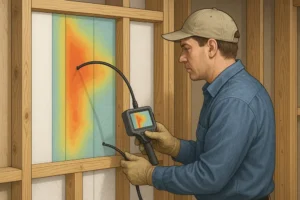
Call in help if you see swollen baseboards, chronic musty odor near exterior walls, visible mold, or if your meter test points to a leak on the irrigation side. Restoration pros like us at All Nation Restoration start with moisture mapping and thermal imaging to find where the water is actually traveling. We document affected materials with meters, set up containment if mold is involved, and use targeted structural drying with air movers, dehumidifiers, and wall cavity drying to stop the damage before repairs start. If we suspect a line break, we coordinate with licensed irrigation repair and plumbing teams to pinpoint and fix the source, then we verify dry standards before anything gets closed up.
If you are not seeing active damage yet and just want to tighten your defense, you can also start with our general exterior and plumbing prevention tips here. And if you are considering sealants or drainage upgrades alongside irrigation fixes, our basement waterproofing guide covers the basics of grading, sealing, and routing water where it belongs here.
We are happy to be the bad cop for sprinkler overspray. We will point out the heads your siding hates, find the underground leak that is soaking your slab edge, and dry the interior so you are not living with hidden moisture. Tweak a few nozzles, fix the leaks, seal the gaps, and keep a dry buffer along the house. That is real-world foundation seepage prevention you can feel good about when the system kicks on at 5 a.m. and your walls are not getting an accidental shower.