By Benjamin Haugh, Founder of All Nation Restoration
If you’ve worked in the water, fire, mold, or trauma cleanup industry long enough, you’ve probably seen some wild stuff. Broken pipes, busted water heaters, attic fires, cracked fish tanks at this point, we’ve seen just about every kind of domestic disaster you can imagine at All Nation Restoration in Austin.
But there’s one kind of water damage I never expected to become familiar with:
overflowing baptismal tanks.
That’s right. Churches, it turns out, flood too. And baptismal tanks? They might be holy but they’re also notorious for sneaky leaks and distracted fill-ups.
Sunday Morning Surprise
We got the call early one Sunday morning. A church in Mueller one of Austin’s charming little neighborhoods had an emergency: their baptismal tank had overflowed just before services. Whoever was responsible for filling it had likely gotten distracted, and by the time they returned, water had already saturated a large portion of the sanctuary and nearby offices.
We showed up and got to work quickly extracting water from the carpet, drying out the floors, and making sure no one had to sit through a sermon with soggy socks. Since services were about to begin, we strategized to return later that evening to finish the job—dehumidifiers, fans, baseboard removal, and cutting out waterlogged drywall.
So far, business as usual.
Or so we thought.
That evening, we returned and got to work. One of my long-time friends and All Nation’s longest-standing employee, Chris was on drywall duty. As he made a cut about a foot off the floor inside a church office, something strange happened.
The drywall came off… and a heap of envelopes fell out of the wall cavity.
Chris stood there, staring down in confusion. The envelopes weren’t empty. They were stuffed with cash some of it old, most of it unmarked and more envelopes just kept tumbling out.
Naturally, Chris called me over. We crouched down, flipping through dozens of envelopes and scattered bills, trying to make sense of what we were looking at. One thing was clear: this wasn’t a lost wallet or someone’s savings. This was something weird.
So I went and found the pastor.
“Uh, Pastor… You May Want to See This”
He probably assumed I was about to give him the usual contractor speech:
“Sir, we’ve uncovered additional damage. Gonna cost you double.”
But instead, I brought him around the desk, pointed at the pile of envelopes and said,
“I have no idea what this is, but… it came out of your wall.”
He blinked. “What is this?”
“Cash. A lot of it. It was just… in the wall.”
After some confusion and laughter and a bit of detective work we figured it out.
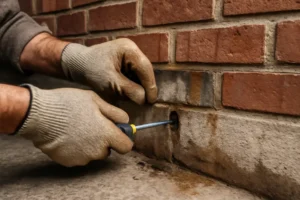
On the other side of that wall was an offering box. You know, one of those built-in slots where people slide in donations. Well, turns out there was a gap between the stainless steel chute and the drywall. And for who knows how many years, generous (and possibly nearsighted) churchgoers had been missing the box entirely and sliding their envelopes into the void.
Somehow, no one ever noticed. Not until the baptismal tank flooded… and we opened the wall.
“This is a Miracle.”
The pastor, wide-eyed and grateful, looked at us and said:
“This is a miracle. We didn’t know how we were going to pay for the water damage—but we were doing the Lord’s work, and He answered our prayer.”
He was sincere. And honestly, I couldn’t argue with him. After all, how many remediation jobs come with divine reimbursement?
We finished the project, set the equipment, dried the structure, and headed out. But to this day, I still think about that job. Not just because it was one of the funniest things we’ve stumbled upon—but because it reminds me how incredible and weirdly poetic this work can be.
And let’s be honest…
If the Lord had just used a high-yield savings account instead of a wall cavity, that money might’ve gone a lot further.
Restoring homes. Rebuilding lives